Thursday, July 20, 2017

Response to Godfather Politics

I was sent an email from a family member copying and pasting from a recent post by Gary DeMar on Godfather Politics. I just spent about 20 minutes rewriting it. Too bad their comment section is limited to 5,000 characters, but maybe this will get back to them somehow. I'll put the link to the original in the first comment.
Think about this for a moment. We are debating how the health care insurance companies should control our healthcare choices by taking away our choices and our money. In essence, we are debating how these private corporations should control our lives. It’s maddening that we are sitting back and letting it happen.
We are an economic version of zombies.
I realize that we didn't have any vote for the people who finance the campaigns of the candidates who said they would repeal Obamacare, but then these elected officials are unwilling to do it anyway because so many lives depend on the current insurance system. Five Supreme Court Justices, appointed by both Republicans and Democrats, ruled in a 5-4 decision that healthcare is the province of the State. It’s amazing. ”O well, I guess we’re going to have to figure out how to do this.” This is a republican democracy of the first order. Is it creeping fascism, creeping socialism, or something else? The debate rages forever.
Who believes that the multi-millionaire business executives are competent to tell the entire health care market how healthcare should be run and financed? What about the doctors that provide the care, the nurses that take care of us in hospitals or the pharmacists that provide our medicines? Shouldn't they have a voice in these decisions? These are literally the same multi-millionaire corporate board members whose banking companies finance our wars, heavy industry manufacturing builds the weapons and extra-governmental economic agents stir the pots in foreign countries directly or even through the CIA that get us into wars that we can’t win and spend money we can't get through taxes so we have to go further and further in debt for.
We’ve already let it happen with education. The education industrial complex is encouraging the privatization of the schools that teach our children and turning them into corporate slaves intellectually and economically, and yet there are the same people — conservatives included– who continue to support teachers unions and public schools financed by our property taxes. If it’s OK to turn our children over to private corporations to be educated, then why not our whole lives?
We need a massive nation-wide uprising. I’m not advocating violence but a loud voice and movement that says, “Stop controlling our lives and controlling our money!”
Let us make our own healthcare choices, without having the cost of those choices drive us into the poorhouse. Once this is done, we won't have to go back and say, “I can’t afford it. Please, save me.” There are fair-market ways to take care of everyone. Other countries already do it, and there are many different models that we can learn from and adapt to our circumstances. All we have to do is look. It might mean extra medical savings accounts to prepare for a medical emergency but many fully developed national health care systems don't require it. And of course we should be driving our cars a year or two longer or backing off on extravagant vacations or not eating out as much. Reducing our footprint on this green Earth is something we all need to take responsibility for.
We really do need to take better physical care of ourselves. Even with all the information we have on smoking and the higher taxes, people still smoke. I watch unhealthy-looking people stand in line and pay $45 or more for a carton of cigarettes. I see fat people waddle around who can barely step up on a curb. These people need motivation to change their habits, and they need the support of a strong community safety net to make sure that they don't fall through the cracks. Nobody is alone in this, if we pull together.
We did need the government when it came to automobile insurance, life insurance, or homeowner’s insurance. All of those insurance systems are heavily regulated on the back end where we can't see them. I can go online and shop for a policy and price for all three of them from a multitude of companies because of those regulations.
Why not do the same for health care? We've tried letting the market take on the job. The problem is that health care is so lightly regulated that any company in the world can claim to be a health insurance company for their own employees or anyone else. Amazon is probably already getting into the insurance business. Same with Wal-Mart? Heck, there are probably some churches that want to create their own insurance pool with their own rules, co-pays, deductibles and decision making panels. With this many actors in the insurance market, doctors and medical providers have to spend Billions of dollars paying people to make sense of it all. Why increase government regulation in the health insurance industry? Because it would save us those Billions of dollars every year!
Market mandated healthcare insurance has driven up costs tremendously, well over and above the natural increase in prices that we have seen over the last hundred years or so. Our grandparents had large families. They did not have to have health insurance, and yet they were able to pay the doctor. Or in GGrandpa James' case he could BE the community doctor and a very respected member of his community. How did they do this? Health insurance is the product of government mandates in the economy during World War II. It was a way to get around the wage and price controls after World War II because Congress was too slow to release those controls and it was also a way to start reducing what companies had to pay their employees. The marketplace did a workaround to beat a government edict, and it resulted in an insurance nightmare that we are now living in.
At the present time, the claim is that “healthcare is plagued by barriers to entry for potential new suppliers of services”, which is false, and “patients do not see bills until after services have been offered,” which is true. No other industry does this, because no other industry has been allowed to get away with it. How many people sign a contract to buy a car before they know the price? Big healthcare companies often won’t allow their own medical facilities to build in certain areas because they have decided that there is no “need” because there is not enough profit in that area for them to make. Governments would love to have new hospitals, doctors offices and other types of medical offices, but if insurance companies decide that they can't make sufficient profit by offering insurance products to the people in a county, then the citizens of that county are left to rot by those insurance companies. There is nothing the government can do in those cases. Competition is supposed to be a good thing in a market, but profit taking is all that the current medical industry leaders seem to care about.
There are dozens of competitive pizza businesses near where we live. That's because competition works when there are enough small players in the game to be able to provide for the market need for that product or service. When big players get into an area, it stifles or destroys all of the other players, and government is helpless to restore those jobs because the tax dollars coming from the big players become necessary for the survival of the municipality. That's when you know that the corporations have really taken over, and it's happening all over the country.

-----
Evidence from other countries illustrates why lowering these barriers to entry is important. In India, Devi Shetty, a surgeon, has taken advantage of economies of scale to develop large, 1,000-bed hospitals that make health care more affordable. Dr. Shetty’s heart treatment hospital charges $2,000 for open-heart surgery—American hospitals average slightly more than 150 beds and charge between $20,000 and $100,000 —while providing high-quality care. Dr. Shetty is currently setting up a chain of similar hospitals in the Cayman Islands to make his services more accessible to patients from the United States as well as the rest of the world.
*****
The U.S. health care system is generally not a competitive marketplace. In particular, current law largely restricts consumers to purchasing insurance within their own states. Additionally, current tax policy offers a tax advantage to employer-based health insurance but not individually purchased insurance, causing most Americans to gravitate toward job-based coverage instead of buying insurance on their own. These distortions, generated by government policy, have largely insulated consumers from their health care choices. (Heritage)
------

These paragraphs are accurate enough, but the fault doesn't lie in the government policy because that could be changed if representatives would just change them. They are prevented from changing them because of the influence of the big players in the market who don't care about anything other than maintaining their own monopoly control.
We’ve seen what the market can do with the airlines after deregulation. More options. But also decreased quality of service, because shaving the food available down to Planters Peanuts and Coke products has saved a lot of money. And the objective of airline design is now to smash as many seats as possible into as small a space as possible. The giant media corporations took control of the broadcast television through well placed government operatives, so the market found a way around it and we got the cable and satellite industry. When consumers grew dissatisfied with fewer options and higher prices, the market stepped in. Now we have Netflix, Hulu, Amazon, and a slew of other competing options, and that's great. But now the Cable companies are trying to take control by offering a version of ala carte services and driving all of the smaller players out of the market. Here's hoping that our anti-trust laws will be used to break these monopolies up like they did Standard Oil and AT&T, which by the way are both back bigger and stronger than ever. The government had a monopoly on mail, so UPS, FedEx, and others got in the package delivery service and the world is better for it. But these corporations are also heavily regulated and many of them use the Postal Service in their own routing of packages because it's cheaper than doing everything themselves.
Email has had a devastating effect on the Post Office, but so has the crazy scheme cooked up by Republicans in Congress that required them to fund their retirement system 75 years into the future in an attempt to destroy it entirely so that the big corporations like UPS, FedEx and others that finance their campaign can earn all of the profits instead of letting the Post Office fulfill it's Constitutionally mandated duty.
Our tax system is certainly a nightmare, and if healthcare insurance is so important to our elected officials, why not make out-of-pocket payments deductible? Because it would mean fewer people paying taxes and they're complaining about that enough already. Why not take the healthcare finance money directly from everyone and then pay the expenses through an efficient government-run program like Medicare or Medicaid which already do that? Of course, we know why — power and control. The insurance companies want the power and control over our healthcare decisions to rest in their hands, not ours. Because don't forget, we are by definition our own government, per our founding documents and based on everything we hold sacred in our country.
If we can fix this mess, there will have to be a transition period to a fair system. But the way we are going, we’re going to get the giant fast food version of healthcare. Would you like fries with that?

Thursday, March 02, 2017

GOP launches effort to replace Obamacare with something that works (Satire)

Republican leaders in the House and Senate held a press conference today to announce their plan to replace the failing health care system in the United States.  Speaker of the House Paul Ryan spoke about their comprehensive solution by describing the thinking process that went into the development of the plan.

“After much deliberation and thought, we have come to a consensus that Obamacare has failed our great country, and that our citizens deserve better.  The principles that guided the development of this plan were articulated very well by his speech on Tuesday night.  Those principles are to expand choice, increase access, lower costs, and at the same time, provide better health care," Ryan said.

“This new plan will allow our young people to remain on their parents plans, will not discriminate against preexisting conditions, will provide choices in the marketplace for health care insurance and doctors, will pay doctors and health care facilities fairly for the wonderful work they do taking care of our citizens, and will help state governments provide for their people by moving decision making power out of the hands of a federal bureaucracy.”

Ryan pledged that nobody currently covered by a plan that came from the Affordable Care Act would lose coverage, and that the 20 million people who still do not have coverage will get access to a doctor soon under the new plan.

“Families in our country are hurting, and we have to fix this dire problem with a solution that works for everyone.”

When asked for specifics, Speaker Ryan said “everywhere you now see Obamacare or the ACA, you will now be required to call our healthcare system by a new name.  You can call it Trumpcare if you like, but after consultations with our base, we have come up with a new name that pleases everyone.  Let the word go forth that the new standard of care on our nation is the American GAS Act.  This will solve all of our problems, I guarantee it.”

Democratic minority leader Nancy Pelosi responded to the Speaker's announcement by asking reporters to look carefully at the details of the legislation and inform the American people that as citizens it is our responsibility to be aware of what is happening on Capitol Hill.  “The exact details of how much tax money it will take to change all references in our laws and administrative procedures, not to mention mandating that all media outlets begin using the new name for our health care system, Trumpcare, is not known yet, and we look forward to those discussions.”

When asked what Pelosi thought of the change to the American GAS Act, she replied, “I will need to speak with Speaker Ryan about what he thinks it stands for, but I'm confident that it means what I think it means after the President's speech.  America gives a shit.  I suppose the base that he was referring to was the oil and gas industry, and they came up with the idea because that industry wanted more advertising.  But then you never know.”

“But please realize,” she concluded, “that this new Act by Congress does not actually repeal any of the aspects of the previous law.  Because all of those provisions are extremely popular with the American People, and even this President is smart enough to realize that removing health care access from people is a bad idea today.  So we'll see what happens but I am of course hopeful for our future.”

Sunday, February 12, 2017

The most terrifying words...

In 1980, while running for US President, Ronald Reagan described the nine most terrifying words in the English language. "I'm from the government and I'm here to help." This was a libertarian battle cry, and it described a world where the free market reined supreme.
It also told the people of my country that we were on our own. That the government was not here to support them, that it didn't care whether we worked or starved, lived or died. That our incoming President of the United States did not care whether we worked or starved, lived or died. Being eleven years old in 1980 I remember watching this speech on television, but I don't remember my grandparent's reaction. Probably because they had left the room in disgust. Being of the Greatest Generation, they knew exactly how much of a lie that was.
In 2003, I heard nine words over the telephone that terrified me. "The results came back, and your cancer is confirmed." I have never been so scared in my life. I was actually at work, and so the first person that I was able to talk to was my supervisor and department director. They could see how scared I was. And they had my back. My employer based health insurance covered it. Without that insurance, my wife and I would likely have had to sell our condo. But not everyone has an employer with the resources and willingness to provide great health insurance to their employees. And so many of our people don't have employers at all, either self employed or not employed. What were they supposed to do if they ever got a phone call like that?
That's why I started getting politically active in 2003. That's why I worked my way up the ranks within the Democratic Party to Chair of my local party organization, and that's why when Bernie Sanders put out the call for Medicare for All in 2015, I dropped everything to help him. Longshot, yes. But my fight with cancer was a shot across the bow, and I wasn't going to take no for an answer.
At the Democratic National Convention in Philadelphia, I stood watching and listening on Thursday night hoping that the winner of the Democratic Primary would say the right thing. These are the words that she used: "If you believe that every man, woman, and child in America has the right to affordable health care, join us." I sat down, devastated. I said then and I say now that we need to do better than that.
This morning I was checking my phone, and someone I got to know during the campaign told me the four most terrifying words in English language. "I don't have insurance." This is a mother with kids, someone who cares about her community and wants to build her community. And she is worried about getting sick. This is not acceptable. This is not tolerable. This is why I fight, and will not stop fighting until we never, EVER, hear those words from anyone in our country again.

Thursday, December 22, 2016

Knock Knock, version 2

Knock Knock
Hello? How can I help you?
Well, I understand that you are having a party, and one of the bands you have playing is one of my favorites! I was wondering if I could join the party.
Did you bring anything for the potluck?
Well, no, I'm between jobs right now so money is tight. But I can grab something if it's required.
Sigh, no, technically it's not required, but it's only common courtesy. You should know that, you're an adult.
Right, thanks. I'll see what I can get.
...
Knock Knock
Hello? Oh, it's you again.
Hi there, yes, I found something I could afford from the store down the street. It's not much but I hope it helps. Oh, I love that song that's playing.
Yeah, it's an old tune but sometimes we like to play it just for the nostalgia. The more modern music doesn't quite have the bite.
And there's nothing like the classics. Can I come in?
Sure, I guess. Just, please take your shoes off, and you'll need to sign this form to say that nothing you hear or see can leave the house.
I don't understand, I thought you wanted more people. This is a really nice house, btw.
Yeah, it's been in the family for a long time. Needs some work, but we never seem to have enough help to get that work done.
I have a whole bunch of friends that I could call.
The house is pretty full already.
But I don't see very many people, where is everyone?
Oh, everyone is in their group space. Each room of the house is for different kinds of music. People usually just go into one of the rooms and stay there unless they need to go to the kitchen or dining room.
That's no fun, why not play different music in a central place so people can get to know each other while they enjoy different kinds of music?
Oh, you know, tradition. It's how we've always done it, and nobody really wants to change.
I know my friends love all kinds of music, they'd love to go from room to room getting to know people and ...
Yeah, that's kind of discouraged. It's distracting. And people here are used to their favorite music.
Oh, come on, it will be fun! Lots of people moving from room to room, talking, singing, dancing. I remember hearing stories about this house in previous times being like that, my Dad said it was a whole lot of fun to be here!
Where did you put your shoes again?
Why, do you want me to leave?
Well, no, but I wouldn't want you to lose anything...

Knock Knock, version 1

"Knock knock"
Hi, welcome! Are you here for the party?
Yeah, I heard about the party from a friend. What's going on?
Well, we want to get people together to talk about how to solve this problem.
What problem? Is it my problem? Do I have a stake in this?
Of course, come on in, let's talk about it. Did you bring anything for the potluck?
Oh, now you're telling me that I had to bring something for the potluck to be allowed in?
No, I just asked if you had brought anything. It's not required, it's just something we do so we can share the load because everyone gets hungry while they talk.
Oh, ok. So am I allowed in?
Of course! Come on in. What is your top issue?
Oh, well, I don't think my issue is your top issue is your top issue, so I don't think I should come in yet. I want to stand out here for a while and listen. Can you set up some microphones and speakers for everyone outside so we can all hear and participate without coming in the house?
"Baby, it's cold outside." Come on in.
You know that's a rape song, right? I don't think I can come in because now I'm afraid for my safety in your house.
Look, it is cold outside, it is raining, in fact there's a big storm coming and I would like to invite you to come inside so you can be sheltered from the storm and so we can talk and work on these problems together.
You don't look like me.
Why does that matter?
Well, because you don't look like me I don't think we can communicate because I don't think your experiences match mine.
You're probably right, but that just means we can tell each other stories and get to know each other better.
But I don't think my stories will be respected because my shoes are wet and that looks like new carpet.
We can wash the carpet. It's more important for you to come in from the rain. Please come inside.
I can't, you're standing in the doorway.
Ok, I'm now giving you whatever room you need to come inside.
But I don't know that I'm actually welcome.
Would you just come inside already?!
Now you're being aggressive, and I don't like that. I don't think I'm actually welcome. And I can still see you, and you don't look like me.
Do you want to join this conversation so we can work on solving these problems?
I see a green field next door. Maybe I can set up a tent and listen to the speakers that you are going to set up and talk into the microphone that you are going to set up for me.
We have plenty of room inside the house, and everyone is welcome.
I don't believe you. I haven't been invited before. At least I don't think that invitation was for me, you spelled my name wrong.
... Look, I have people who are waiting for me to rejoin the conversation. I'll just leave the door open and you can come in if you want to. I'll be in the other room.
I can still hear you. I think you're talking about me now. I don't like that.

Wednesday, December 07, 2016

Washington State Progressive Caucus, it's time for me to return.

Announcement:

It is my intention to run for Chair of the Washington State Progressive Caucus at the January reorganization meeting.  If you have seen my posts and plans for the state party, the community inclusion effort includes introducing an amendment to the State Party Bylaws that formally codifies the existence of the Constituency Caucuses, and identifies in language the reason they exist, which is building bridges to all of our communities around the state and organizing local caucus structures in the Congressional Districts, Counties and Legislative Districts over the next few years as part of an overall Community Inclusion strategy.  It's long past time to do this, and I'd like to build on the efforts that the current Board has already started that I heard about at the September WSDCC meeting.

For anyone who does not know me, I was born in Seattle, raised in Kent, spent 6 years in the US Navy, owned a small business in Everett in the 1990's, work for Nordstrom now, and I've been involved in the Democratic Party since 2003.  I've been on the Executive Board of the 46th LD since 2005 as an At Large member, KCDCC Rep and Chair.  I was one of the primary organizers for Bernie Sanders in 2015-2016, including being a National Delegate to the 2016 National Democratic Convention.  I am currently on the Washington State Democratic Central Committee from King County, elected this past Sunday.

I am one of the founders of this Progressive Caucus in Washington State, and was Chair in 2007-2008 until I stepped back to focus on being Chair of the 46th, 1st Vice Chair of King County and Chair of the Washington State Democratic Chairs Organization in 2011.  I stepped back in 2012, but returned to help Bernie get 74% in our state and 46% nationally.  I am currently involved in national organizing efforts to encourage and train progressive activists on how to be effective agents of change in their local and state party organizations so that we can promote our values and push our policy objectives into law.

My top issues are Single Payer Health Care, Climate Change Action and Economic Opportunity for All.  I have been writing, blogging, organizing and planning for 12 years.  I have a degree in Business Systems Analysis, and I want to put those skills to work building the strongest Democratic Party that this state and this country has ever known.  I ask for your vote.

Wednesday, November 30, 2016

What does it mean to be Progressive?

Whenever I use the word Progressive, I have some people agree with me, and others looking confused or frustrated. It's easy to understand why. Progressive is a very subjective word, with multiple meanings coming from individuals and situations. Wikipedia has this definition:

"Progressivism is a philosophy based on the Idea of Progress, which asserts that advancement in science, technology, economic development, and social organization are vital to improve the human condition."

I've been reading about and participating in progressive politics for a few decades now, both in and out of the Democratic Party. This is my framing and it consists of four parts.

Grassroots, People-Powered Democracy

If a decision is being made on any level of government that affects you, your voice should be heard on that issue. What we need in this country and around the world is a way for people to get directly involved in the way our government operates. Many opportunities exist now, but they are hidden behind a wall of secrecy and only the hard-core activists seem to be able to break through. We have to make the process of electoral, issue based and identity based politics transparent and open so everyone can get involved, however that works for the individual.

The Concept of WE

The Earth is a single environment. Everything that affects individuals affects groups, and the larger the subject, the larger the group that is affected. I'm tired of hearing people describe the world in terms of 'us versus them'. We're all on this planet together, and the more we understand that, the better we will be able to create a world that works for everyone. How can we get a better understanding of how everyone is linked together, and that something affecting one affects us all?

Understanding the Past

Where do our problems come from? How do they relate to each other? If we search for an understanding of our past mistakes, we gain a better understanding of how not to repeat them. Maybe we can even solve two problems with the same action. Critical Thinking requires that we have an understanding of the foundations we stand on before we start building.

Looking to the Future

It's not enough anymore to think and act for the moment. In the big picture, we are creating the world of the future by our actions today. I'm concerned about how my children are growing up, but I'm just as concerned about the kind of world their grandchildren will be living in. We should grant them the power to turn that world into whatever they wish it to be, with clean air and water, energy resources to explore their dreams, a peaceful world where people talk instead of fight with each other. What can we do now, either big decisions or small actions, that can help to create that world of opportunity?

What is your definition? What is your framing?

Wednesday, November 23, 2016

PCOs and friends, I need your endorsement.

Campaigns are not won by the candidate.  Campaigns are won by the community that supports that candidate.

I'm running for King County State Committee Man to represent the Democrats in King County, and I need your help to win this race.  Please let me know that you support my efforts to build a strong community in order to help heal our world.  If you are an old friend who has been with me through this entire journey, I'd love to hear from you.  Let's talk about history, enjoy some stories and plan for the future.  If you are new to the party, I welcome you with open arms and an open heart.  Please tell me your dreams and ask questions about how we can do this together.

There are 1,144 PCOs in King County, and I'm trying to reach out to each and every one.  I have worked with and met with elected officials, movement leaders and party leaders all across the state and around the country.  Please help me build this community by making connections with each other as we move forward.

You can endorse me on my campaign page, you can send me an email that I can share, or you can send me a message.  I hope to hear from you.

A longer tunnel

Welcome to the KCDCC!

Dear Elected PCOs

My name is Chad Lupkes, and I would like your consideration at the December 4th reorganization meeting of the King County Democraic Central Committee for the position of State Committee, identifying as Male.  I know we have multiple people interested in this position, and I welcome the vigorous discussion that I hope will occur in just two and half short weeks.

I have been working within and around the King County Democrats and the state party for well over a decade now.  I could go over that history in detail, but I've already written about it extensively when I ran for National Delegate for Bernie Sanders at the May 21st CD Caucus.  I could also give an detailed description of what I want to do on the State Committee, but I've already written about that as well.  In fact, I write a lot, and most of it comes out as a firehose of rants and opinions and links and forwards on my Facebook page.  If I'm not already connected with you on social media, expect a connection request.  If we are connected, expect more from me.  I'm not running for a "leadership" position, because I see the State Committee as a representative position.  And what elected officials, both government and party, need to be is Responsible, Representative, and Responsive.  
Just over the last year, I have
  • Launched and helped maintain social media infrastructure for Bernie Sanders.
  • Been a Delegate at every stage of the 2016 Caucus cycle, up to and including the National Convention.
  • Kept contact with the Delegates from Washington and around the country.
  • Encouraged progressives to file for PCO and become more involved in the Democratic Party.  #DemEnter or Bust.
  • Helped with GOTV and Party events around the state, from Seattle to Spokane to Vancouver.
I joined the party in 2003 hunting the smoke filled rooms in order to open them up.  I either didn't find them, or found them to be a very different thing than I expected.  No door has been closed, so far.  If a decision is going to be made, I will be talking about that decision and hearing feedback.  I know who will be making those decisions, and I have ideas about how to influence them.  I know how to help people become the decision makers.  The State Committee members represent their County Central Committees or their Legislative District organizations.  So I will represent you, while you represent your precincts and the voters in your precincts.  We also have several thousand additional precincts to fill with Appointed PCOs between now and 2018.  I am an organizer at heart, especially on social media.  It is what I have always done, and will continue to do locally, at the state level and nationally.  I also have plans and dreams to build on what I have done over the last decade in order to support progressive candidates all over the state, push our progressive agenda into all levels of government, build our party stronger than we have ever seen it before, and strengthen our communities in ways that we have not seen before, or at least not for a very long time.

Connect with me on Facebook.  If we are not already connected, send me a private message so I can approve it quickly.  I'm well over 4,000 connections, and Facebook has a limit of 5k so I'm being careful at this point to make sure that I can directly connect to the people I need to communicate with.  I want to connect with you and hear from you.

Follow me on Twitter at @chadlupkes, and let's use this tool to amplify our conversations.  I don't use Twitter as much as Facebook, but if it exists in the Social Mediaverse, I'm there somewhere.
As an Elected PCO, you will vote on December 4th for the Officers of the King County Democratic Central Committee. The meeting will be at 12pm / Noon at this union hall:

IAM Machnists Hall - Seattle
9125 15th Place South
Seattle, WA 98108

Ask me questions. If I don't know the answer, I will help you find the answers.  I've been dedicated from the very start to engage, inspire, educate and empower.  That won't change.

Many of you already know me from the work that I've done in the party and during the 2016 Presidential Primary.  I was the insider trying to bring new people in.  I was the establishment welcoming new voices.  I tried my best to walk the fence, because I was waiting and hoping that the fence would no longer be necessary.  I didn't want to make enemies on either side, because that makes the work harder.  Now the election results have knocked that fence down by force and we have to build bridges, not burn them.
We do have a longer tunnel ahead of us.  And there will be turns and strange noises on the tracks.  But the light at the end of the tunnel is still there.  I know it is.  It's up to us to make sure that light doesn't get turned off.


Sincerely,

Chad Lupkes
PCO, SEA 46-2324


Saturday, October 08, 2016

I'm running for State Committee from King County

 I've decided to run for the State Committee Man position from King County.
I have been working within and around the Washington State Democratic Central Committee for 12 years. I have known three state party chairs, all three that I consider friends. I have seen four Presidential Cycles, and many off year elections. The new energy and incredible new activists that came into the process in 2016 thanks to Bernie Sanders AND Hillary Clinton inspired me from the very beginning of the caucus cycle last year, and while I supported Bernie Sanders 100%, I know that the only way we are going to accomplish any of our goals is by working together for the same agenda. Our platform, our values, our kids.
I want to see a revival of the Democratic Party in Washington State. I believe that there are aspects of the party that have atrophied over the last few decades, and I want the party rebuilding its full potential. Our country needs the FDR coalition to be rebuilt. We need our labor movement supported by our elected officials. We need our communities of color to know who to turn to. We need our immigrant populations to feel welcome and valued. We need our sovereign Native allies to feel the same security and respect within their borders that we desire to feel within ours.
Electorally, we need candidates in every election, from US Senator down to the most local special district. Our candidate recruitment efforts need to be boosted, and we need to recognize that the lowest level of the farm team is actually municipal boards and commissions. Working with our incumbent elected officials, I think we can build a list of those positions across the county and across the state and open doors of opportunity for our PCOs and activists to get involved with actual governance.
Legislatively, King County has an active committee that works hard to push our platform into law. But that type of engagement needs to be distributed, and it needs to be transparent in order to thrive and grow. There was a proposal for a Legislative Action Committee at the state level presented at the State Convention, one that would take significant resources to implement. We need to talk about our options, recognize our limitations, and do what we can with what we have. I believe that a distributed network of activists can be brought together through communications infrastructure. I've watched pieces and parts of this infrastructure rise and fade many times over the past decade, and I really believe that we now have the tools and teams that could really make something work.
Party building means a lot to me. I believe that the Democratic Party is THE Progressive Party in the United States, or at least it could be if people would get engaged and STAY engaged in the processes that make the infrastructure work. We need to understand the role of the party in the overall progressive movement, and we need to be an open door to progressives who actually want to work to improve our world. PCO recruitment begins on December 1st to fill every single precinct in the county, and eventually every single precinct in the state. I've been working to build this reorganization cycle into a transformation event.
And finally the most overlooked aspect of our party is our Community Outreach. I've seen outreach efforts bear fruit in North Seattle where we built lists of neighborhood groups, activist groups and non profit organizations that we can consider allies, then sent people to those groups to invite them to community outreach events. We did a District Profile dedicated to documenting this research work. That kind of profile should be a standard across the state.
If a citizen comes to us with an issue, we will know how to help them answer the three core questions of activism.
What decision is being made?
Who is making that decision?
How can I influence that decision?
In addition, we need to be the place where people with those answers go to take the biggest step, which is becoming the decision maker, running for office, becoming the decider. This is what I want to build for my State Democratic Party. And I can't do it alone. I'm very serious when I say it's time for a revival, a revolution, in our political spheres. Climate Change is the most important threat that we face. Inequality and injustice permeate our society from top to bottom. Our economy is struggling, being undermined by the Profit or Die Corporations at the top and the lack of funding for education and research at the base.
We are the Democratic Party. We must rebuild the FDR coalition. That's what I want to do.

Friday, May 20, 2016

Why me, why now

My name is Chad Lupkes, and I’m asking for your vote on May 21st, as well as your help over the next few years. This Political Revolution goes beyond 2016, and we’ve always known that.
I was born in Seattle and raised in Kent. I’ve lived in the Puget Sound my entire life, except while I was in the Navy. I owned a progressive bookstore and gift shop in Everett for three years in the 1990’s, and went to a private university to rack up school loan debt that I’m still paying off.
One of my classes was State and Local Government, and one of the assignments was to attend a meeting of a political organization. I had not been cognizant of how the party was structured, so I discovered that I lived in the 46th LD, and that the meeting of the 46th LD Democrats was the next night. I attended, and it was really, really “interesting”. Supporters of Lyndon Larouche were standing on chairs singing protest songs because their candidate wasn’t being taken seriously enough to be invited to the Democratic candidate debates. The police pulled them outside, and I volunteered with the party immediately. I started looking at how to improve, i.e. build from scratch, a website that would actually accomplish what they needed done during the run-up to a Presidential Caucus cycle. I had a lot to learn, so I started by transcribing the entire PCO Handbook into a website. You can still find that site on my Seattle Webcrafters domain.
Then my wife felt some lumps in my neck, and I went to get them checked out. The Nurse Practitioner at my doctor’s office told me to sit tight and she made my doctor drop everything. He then got on the phone and made an appointment for a CAT Scan across the highway, immediately. After a few days, I had a biopsy scheduled at Swedish Ballard. And a day or so later, I got a confirmation phone call saying that I had Stage II-B Hodgkin's Lymphoma.
I had started working for Nordstrom in 2000, and I had their health care insurance. I’m really glad that I did. When the EOB’s started coming in the mail, we realized that without that insurance, we would have had to sell our home to pay those bills. Then I heard someone talking about how 47 Million people in our country, in MY country, didn’t have any health insurance at all. They couldn’t even make an appointment with a doctor, let alone get anything else. That was Howard Dean, and that was my wake up call. I have been Single Payer or Bust ever since.
While going through chemotherapy and radiation treatments, I continued to build the website of the 46th, along with a few others. I started reading history about how the political evolution of the Democratic and Republican Parties have gone over the entire history of our country. I read about the Progressive Era and the Long Gilded Age, and started really putting the pieces together about what had gone wrong. And how to put it right. I got more involved.
I caucused for Howard Dean at the 2004 Precinct Caucuses. I ran for PCO. And lost, by 1 vote, to a supporter of Lyndon Larouche whom I actually never saw again. She moved away before the 2006 cycle and I was able to take the PCO position officially. In the meantime, I joined the executive board of the 46th LD as an At Large member in 2005, then became the King County Committeeman in 2007. I became the chair of the 46th in 2009, as well as vice chair of the King County Democrats, and vice chair of the Chair’s Organization.
I attended the Seattle launch of Howard Dean’s Democracy for America, and helped launch the state level organization, Democracy for Washington. After several years of work trying to keep the people who had been inspired by Howard to stay engaged with the party, we realized we had been successful and folded the organization into Progressive Majority Washington. All of our members were active officers within the Democratic Party.
I also helped form the Washington State Progressive Caucus, starting within the 46th LD where we had meetings the week before the district meetings in order to talk about the upcoming agenda and have a more in depth discussion about the issues, debates, votes, endorsements, and whatever else was happening in North Seattle. We actually held the first candidate forum for the position of State Party Chair in 2006 when Paul Berendt stepped down after 11 years. The members of the executive board were not sure what was happening until we invited the district chair to sit in at a meeting. He stopped worrying and started helping us.
I had caucused for someone in 2008 that I choose because of the message he had been putting out. I didn’t yet know that the Edwards campaign was defunct, although we on the state steering committee knew he wasn’t going to stick with it. I had watched both the Obama and Clinton campaigns through the summer and fall of 2007, and only the Obama campaign really built a grassroots organization that I could find. When we got to the precinct caucus, I switched to Obama. But I didn’t run for national seriously because many others had done the work over the previous year, and they needed to go.
After the success the Democratic Party had in 2006 in gaining back control over the US House and Senate, and the intense health care debates that seriously mirrored what had been seen in 1993, we saw 2010 coming and really couldn’t do much to stop it. Then the 46th had a shock. Our State Senator Scott White, who had been the district chair that attended the progressive caucus meeting in 2006, died suddenly in October, 2011. He was a good friend, mentor, former chair of the district, and someone I really wanted to see continue into higher and higher office. He had one of the largest hearts I knew, caring about everyone. His doctor never caught the fact that it was too large. The resulting contests within the 46th LD to fill his vacancy, and then the State House vacancy that came from David Frockt taking his place in the Senate, tore the district apart. At least that’s how I saw it. I didn’t have time to grieve. I ran the vacancy appointment meetings, and watched the executive board split down the middle. It burned me out. I started making mistakes during meetings, and it got to be too much. I resigned as chair, stepped away from the party, and focused on my family for a while.
During this whole time I had been listening and supporting Progressive Talk radio, especially Thom Hartmann. I loved Fridays, when “America’s Congressman”, who in 2006 became “America’s Senator” would give an hour of his time to tell the truth about how things were going in Congress. Bernie Sanders never strayed off message, never gave into despair, and always gave me hope that someone, at LEAST one person in DC had my back. I knew about the Congressional Progressive Caucus, one of my good friends had worked as the Executive Director of the Progressive Congress organization. (Darcy Burner is now running for the State House in the 5th LD.) In early 2015, I wasn’t sure what I was going to do during the next caucus cycle. I looked at Martin O’Malley, and mostly liked what I saw. I wasn’t thrilled with Hillary. I knew all about the Third Way Coalition, and I really didn’t want a repeat of the 1990’s.
Bernie Sanders announced his intention to run for the Democratic Nomination on April 28th. I announced on that same day that I was in. This was (is) a drop everything moment. I started the Facebook group “Washington for Bernie Sanders”. I brought in my best friend Mario Brown to start the Page and to help me build the organization. The mission was to maximize the number of delegates that Washington would send to the National Convention in Philadelphia.
I worked with grassroots leaders from all over the country setting the foundations for Bernie’s domination of social media. I worked with Bernie2016.tv over the summer to capture and rebroadcast as many speeches as we could. Mario and I were asked to lead the volunteers when Bernie first came to Seattle in August. And Mario and I started doing caucus training sessions every weekend somewhere around the Puget Sound area, telling people how this could actually succeed. We were not selling the idea of Bernie Sanders as President, he was doing that just fine. What we were focused on is how the grassroots could actually win. And people responded. We have had people step up in all 10 Congressional Districts, and most counties and legislative districts. We got Votebuilder access in December, and started providing lists for people to canvass their neighborhoods. We started promoting the phone banks that were going into Iowa and New Hampshire.
When staff arrived in Washington, they met with us and our team. For the very first time, a presidential campaign came in and said they wanted to amplify and magnify what we were already doing, not take over or start over from scratch. Instead of giving orders, they asked us what we needed, and then made it happen. The closer we got, the more we all focused on phone banks going into our own state. We knew what could happen if we stayed focused on positive campaigning and empowering the grassroots. But what actually happened was far and away beyond our expectations.
Obama in 2008 got 67.56% at the precinct caucuses. On March 26, 2016, Bernie Sanders got 72.7%. We won every county. The lowest number was 60% in King County. We had done it. It had never been about what I could do on social media, or what Mario and I could do with trainings, it was about what everyone who was inspired could do when we worked together.
I have been trying to gather delegate lists and provide them to people who need them. We’ve been doing video calls so I can answer questions from all over the state, and joining in the campaign calls. Members of our team built the website fileforpco.com which is promoting the idea of keeping the Political Revolution alive after the Convention and after November. We’ve done this before. We can do it again. We can built a better tomorrow.
I want to tell this story in Philadelphia. I want to listen and talk with people from all over the country, people given hope that if we work together we can really achieve a better tomorrow. People excited by the possibilities of political action, not disappointed by what the corporate media tells them to think. I need your vote to make that happen. I need your help to spread the word and tell people that this was never just about one candidate, one office, and one election cycle.
I know how to work within the Democratic Party to enact change. I’ve done it. I know how to build external party groups and use them to expand the outreach efforts of the party to the progressive movement as well as push issue positions and policy ideas from the larger movement into the party. I’ve done it. I know how to teach people to answer the three core questions of an activist: “What decision is being made?”, “Who is making that decision?”, and “How can I influence that decision?” Answers to those three questions are what drive change.
In 2008 the slogan was “Yes we can”. In 2016, it’s “Oh Yes We Will”. No matter what they say, we’re going to build a world that our children can grow up in. We’re going to build a future.
Together.
I ask for your vote on May 21st.

Thursday, July 30, 2015

Socialism, the real history, the real definition, the real path, according to Professor Richard D. Wolff

I've posted my own views and articles about what Socialism means to me, trying to view things in a different way. I found these videos today that just blow me away. They're fantastic, both from the historical perspective and in their way of explaining the real difference between Private Capitalism, State Capitalism (Communism) and true Socialism. There are a few hours of watching here. Worth every second.

The Game is Rigged

https://www.youtube.com/watch?v=XlhFMa4t28A

Socialism for Dummies, Part I

https://www.youtube.com/watch?v=ysZC0JOYYWw

Socialism for Dummies, Part II

https://www.youtube.com/watch?v=HMUuw_K-ky0

Wednesday, July 22, 2015

A wake up call, for me and many others

Bernie2016tv did a vigil on Tuesday, July 21st for Sandra Bland. After what happened at Netroots Nation, we started a specific project chatroom about how to reach out to the ‪#‎BLM‬ community and try to create a bridge between the grassroots activists trying to get Bernie the nomination and the activists trying to bring attention to the issue of police violence against the African American community in our country.
During the broadcast, I decided to try and post the names of those killed by police violence in the live video chat. So I looked for a website that would give me the names. I found one.
I started typing in the names, just copying and pasting. I figured 2008 onward would be good enough. There can't be that many, right? Our country is not THAT far gone, and our police aren't that bad. Right?
Wrong.
I ran out of time before I could even get to 2011.
Creating a memorial video is nice. But each individual tragedy deserves an hour. And such a vigil would take days. Weeks. Months.
This is not homicide. This is obscenity. The #BLM community ramps that up to genocide, and I can no longer disagree. I'm ashamed to say that I too thought this was a distraction from "larger issues". Thanks to this vigil, I've learned something today. The list, the sheer volume, is why it's important. That's why they climbed onto the stage. This is why they take the mic. Because there is no other way to get our attention to the issue. The issue of police violence is not a distraction.
I still believe that Climate Change is the "biggest" issue we face. Because it is going to kill us ALL if we don't deal with it. But I will never again consider the #BLM to be a distraction from "more important" issues. Because while some issues might be bigger than others, they are all equal in importance.
And thanks to these 76 names for teaching this to me. I hope this post helps to teach others.

Thursday, April 30, 2015

Is our story a Comedy or a Tragedy?

In drama, I was taught that there are two main types of stories.  Comedy or Tragedy.  These two forms of story telling go back to the Ancient Greeks and were used by Shakespear and his contemporaries.

In a comedy, the characters are taken on an adventure, but the adventure does not fundamentally change who they are, how they think or how they feel.  When the adventure is over, life continues on, perhaps slightly changed but not fundamentally.

In a tragedy, the adventure fundamentally changes the characters, or in many cases ends the characters lives.  Having the characters die is what we are most familiar with.  Hamlet, Romeo and Juliet, Oedipus.

My question right now is this; Is the story of the United States of America a comedy or a tragedy?  Will we be fundamentally changed by being distracted by pretty baubles, or will we get ourselves back on track?

The answer really depends on what you see as the character of our people.

Monday, February 09, 2015

Can we please balance the budget?

The GDP of the United States was estimated to be $16.8 Trillion in 2014. The "GDP per capita" was $37,075.50. (Now, given that this calculates a total population of 316.1 million people, I'm guessing that some of that is business to business. We don't have that many wage-earners in the US yet. But I'll use the number anyway.)

The 2014 Federal expenditures were $3.7 Trillion. That included a $483 Billion deficit.

If every wage earner, both individual and business, paid the same flat tax rate to the Federal Government, that tax rate would need to be 22.44%, or an average of $11,927 out of that $37,075.50. (by the way, that doesn't take into account the number of actual wage earners, it's total population in including our kids and elders.)

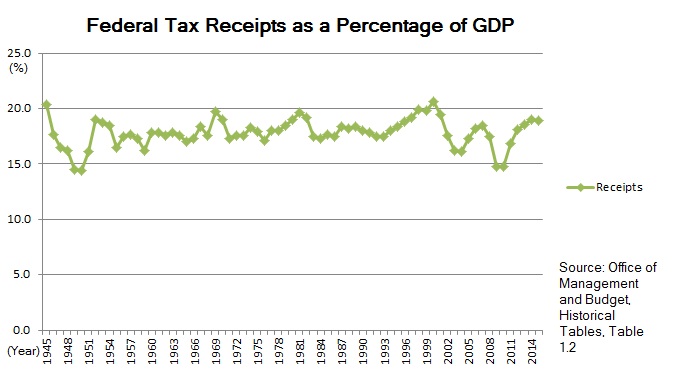
Now, 22.44% is a slightly higher tax rate for Americans than we are used to.  Here's a graph showing what it has been over the last half-century:

http://upload.wikimedia.org/wikipedia/commons/7/75/U.S._Federal_Tax_Receipts_as_a_Percentage_of_GDP_1945%E2%80%932015.jpg

If you consider that with a balanced budget we could really get serious at creating jobs, rebuilding our crumbling infrastructure and actually start paying down the Debt, maybe this would be worth it.

But, nobody is talking about charging everyone $11,927.  Some people earn more, and they pay more.  Some people earn less, and they pay less.  But if we all paid our share, and we stayed focused on the idea that we need to pay enough to balance the budget, we could.

Do we want to?  I do.

Saturday, April 26, 2014

Fixing our monetary system

Our current monetary system has three major flaws. What we have to do is find a way to manage these flaws.

The first problem is Fiat Currency. We need currency based on something tangible, not just promises to pay. But we can't go back to the gold 
standard, and the suggestion of sunshine that I saw in an earlier comment wouldn't work because it would give equatorial regions an advantage. My idea would be a currency based on carbon. Not carbon credits, but actual carbon pulled out of the atmosphere and stored in bulk. It's physical and measurable.

The second problem is Fractional Reserve Banking, where banks only have to maintain a fraction of their deposits in the central bank in order to give out loans. This is simply a matter of law. In the 1930's, with the bank reforms pushed through by FDR, the reserve requirement was pushed up. The higher the reserve requirement, the less money the private banks could just invent out of nowhere. This helped keep inflation under control, but I don't think it ever got above 26% in the US. It's much higher in some other countries.

The third problem is Compound Interest, where we pay interest upon interest upon interest again and again and again. I recently got a debt consolidation loan that had a fixed rate, without any compounding. It's wonderful. I think all loans and credit cards should be like that. Need a loan for 10K at 10%, you'll pay $1K in interest for a total of $11,000. That's it. This could be required by law.

The banks would fight these changes tooth and nail every step of the way, but if we made changes like these it would bring our monetary system to heel and make it a servant of the people instead of our money being our master and us being the slaves.

Sunday, March 30, 2014

From Washington State Democrats, how to help Oso

Like you, we are stunned and devastated by the destruction caused by the Oso mudslide.
We’ve already lost over a dozen Washingtonians. With many still missing, this could be one of the deadliest natural disasters in state history.
When one community in our state is hurt, it hurts us all. Our hearts are breaking for the victims taken by this disaster, their families, and all those affected.
With tragedies like this, heroes emerge. We learn about the strength in our communities that we didn’t know was there.
We thank and honor the first responders, relief organizations, civic and government leaders, volunteers, and all those who are working day and night to help those affected.
It’s hard not to feel powerless at times like this. But a donation to help the relief effort is one way that we can do our part.
In solidarity,
Jaxon Ravens
Washington State Democrats Chair

Monday, October 07, 2013

Learn more about the ACA (Obamacare) at Planned Parenthood!

Want to learn more about the Affordable Care Act?  One of the best places to go (in my humble opinion) {Wait, have I ever had a "humble" opinion?} is Planned Parenthood of the Great Northwest.  They have twelve ACA In Person Assisters (ACA-IPA) {Sounds like a beer from Elysian}, and they are in PPGNW clinics in the following cities:
Centralia, Everett, Lynnwood, Marysville, Olympia, Port Angeles, Puyallup, Shelton and Tacoma.

In addition, clinics in King County are looking for a few good volunteers {Interviews in progress} to provide assistance to people looking for more information.  It's an unfunded contract, but if you're interested in helping people that's a great place to go!  And they will be there until coverage begins in January, at least.

Here's a web page to learn more:
http://www.plannedparenthood.org/ppgnw/affordable-care-act-41851.htm

And here's a paragraph from that page that applies:

"If you are interested in talking to an assister or setting up an appointment for enrollment assistance: Call 206-320-7610 or send an email to ipa@ppgnw.org.  Include your zip code, and someone will get back to you."

Wednesday, May 01, 2013

The path across the Rubicon

I saw a post on Facebook linking to an NPR article about how the US Treasury is paying down $35 Billion dollars of the National Debt. This is the first time in 6 years that they have done this, so before the 2008 crisis. A couple of questions come to mind.

First, how are they doing this? Are they retiring some of the Treasury bonds early? Normal Treasury bonds are 30 year bonds, although they have shorter term bonds out there as well. Which ones are they paying off? Who owns them?

Second, if this was done 6 years ago, sometime in 2007, why don't I remember hearing about it? Is this something that the Treasury does on a semi-regular basis, no matter who the President is? It reminds me of posts in 2009 up to today clamoring for the President to re-install the solar panels on top of the White House that Reagan had removed in 1981. Actually, if you truly pay attention to the news, you would have knows that President Bush reinstalled them through the National Parks Service near the end of his first term in 2003. Not everything is black and white. I wouldn't have expected a Republican President to direct the Treasury to pay down the National Debt, but I guess he must have.

Third question came from another search result that came up when I was looking for more information. It seems that NPR did a story about a government report from the year 2000 talking about the changes that would need to happen if the Federal Government was able to retire ALL of the debt. There are some major foundational aspects of our financial and monetary system that would have to change, and the report talks about them.

First, investors looking for an asset free of credit risk can no longer count on an abundant supply of U.S. Treasury securities, and Treasury securities may no longer provide a reliable benchmark for other interest rates.

Second, the Federal Reserve may have to change the mechanisms by which it conducts monetary policy.

Third, continued surpluses after the public debt has been paid off will require the Federal. government to acquire assets; either directly or though the Social Security Trust Fund. This raises issues about what kinds of assets might be acquired, and the best way to manage this task.

This research brought me back to a concept I've been thinking about for several years, wondering how a government agency could operate without debt. I believe that our monetary system has flaws, and they have been identified many times in many different venues. The most blatant expression of them was in the movie Collapse, which is about the work of Michael Ruppert. He identifies three main issues with the current monetary system.

  • Fiat Money, value set by a promise, not connected to any real commodity like Gold.
  • Fractional Reserve Banking, with banks only required to hold a percentage of their on-book assets in the central bank.
  • Compound Interest, meaning that we pay interest on interest on interest when we take out a loan.

There are solutions for these issues. It's not easy, and it takes a great deal of change in the way we think about money. But it would be possible. If anyone is interested, I can expand on these ideas and continue. But please let me know that you're reading by commenting below.

Tuesday, January 08, 2013

Basic Mortgage Rules

This is a list of the fundamental rules that should apply to all mortgages, at least if we want the housing market to be part of the foundation of the economy.  Any relaxation of these rules, at least given our current monetary system, threatens to undermine the entire system.

1. 30 year fixed rate.  No  more variable rate mortgages.  If someone signs to buy a house, it needs to be a fixed rate for the entire length of the mortgage.

2. Max 30% of household income.  If someone doesn't earn enough to pay the calculated mortgage payment based on the 30 year fixed rate, then they can't afford the house and should not qualify for the mortgage.  It's just too hard on families to have 40%, 50% or more going into housing.

3. Minimum 20% down payment.  Saving money is a critical skill, and if someone can't save up money to pay a down payment on a home, then they don't have a handle on their finances well enough to be a secure credit risk.

4. Mortgages may not be sold to other banks.  No more mortgage backed securities or derivatives.  If a bank goes out of business, that's another can of worms, but a bank should be held to the risks of the loans they issue.

These are severe restrictions on the current housing market.  I know that.  I also know that foundation level rules like this create a way to prevent people crashing through the floorboards and our entire economy held hostage by foolish investors who don't live in or care about the communities they are lending to.  It's just too expensive not to establish rules like this.