Wednesday, November 30, 2016

What does it mean to be Progressive?

Whenever I use the word Progressive, I have some people agree with me, and others looking confused or frustrated. It's easy to understand why. Progressive is a very subjective word, with multiple meanings coming from individuals and situations. Wikipedia has this definition:

"Progressivism is a philosophy based on the Idea of Progress, which asserts that advancement in science, technology, economic development, and social organization are vital to improve the human condition."

I've been reading about and participating in progressive politics for a few decades now, both in and out of the Democratic Party. This is my framing and it consists of four parts.

Grassroots, People-Powered Democracy

If a decision is being made on any level of government that affects you, your voice should be heard on that issue. What we need in this country and around the world is a way for people to get directly involved in the way our government operates. Many opportunities exist now, but they are hidden behind a wall of secrecy and only the hard-core activists seem to be able to break through. We have to make the process of electoral, issue based and identity based politics transparent and open so everyone can get involved, however that works for the individual.

The Concept of WE

The Earth is a single environment. Everything that affects individuals affects groups, and the larger the subject, the larger the group that is affected. I'm tired of hearing people describe the world in terms of 'us versus them'. We're all on this planet together, and the more we understand that, the better we will be able to create a world that works for everyone. How can we get a better understanding of how everyone is linked together, and that something affecting one affects us all?

Understanding the Past

Where do our problems come from? How do they relate to each other? If we search for an understanding of our past mistakes, we gain a better understanding of how not to repeat them. Maybe we can even solve two problems with the same action. Critical Thinking requires that we have an understanding of the foundations we stand on before we start building.

Looking to the Future

It's not enough anymore to think and act for the moment. In the big picture, we are creating the world of the future by our actions today. I'm concerned about how my children are growing up, but I'm just as concerned about the kind of world their grandchildren will be living in. We should grant them the power to turn that world into whatever they wish it to be, with clean air and water, energy resources to explore their dreams, a peaceful world where people talk instead of fight with each other. What can we do now, either big decisions or small actions, that can help to create that world of opportunity?

What is your definition? What is your framing?

Wednesday, November 23, 2016

PCOs and friends, I need your endorsement.

Campaigns are not won by the candidate.  Campaigns are won by the community that supports that candidate.

I'm running for King County State Committee Man to represent the Democrats in King County, and I need your help to win this race.  Please let me know that you support my efforts to build a strong community in order to help heal our world.  If you are an old friend who has been with me through this entire journey, I'd love to hear from you.  Let's talk about history, enjoy some stories and plan for the future.  If you are new to the party, I welcome you with open arms and an open heart.  Please tell me your dreams and ask questions about how we can do this together.

There are 1,144 PCOs in King County, and I'm trying to reach out to each and every one.  I have worked with and met with elected officials, movement leaders and party leaders all across the state and around the country.  Please help me build this community by making connections with each other as we move forward.

You can endorse me on my campaign page, you can send me an email that I can share, or you can send me a message.  I hope to hear from you.

A longer tunnel

Welcome to the KCDCC!

Dear Elected PCOs

My name is Chad Lupkes, and I would like your consideration at the December 4th reorganization meeting of the King County Democraic Central Committee for the position of State Committee, identifying as Male.  I know we have multiple people interested in this position, and I welcome the vigorous discussion that I hope will occur in just two and half short weeks.

I have been working within and around the King County Democrats and the state party for well over a decade now.  I could go over that history in detail, but I've already written about it extensively when I ran for National Delegate for Bernie Sanders at the May 21st CD Caucus.  I could also give an detailed description of what I want to do on the State Committee, but I've already written about that as well.  In fact, I write a lot, and most of it comes out as a firehose of rants and opinions and links and forwards on my Facebook page.  If I'm not already connected with you on social media, expect a connection request.  If we are connected, expect more from me.  I'm not running for a "leadership" position, because I see the State Committee as a representative position.  And what elected officials, both government and party, need to be is Responsible, Representative, and Responsive.  
Just over the last year, I have
  • Launched and helped maintain social media infrastructure for Bernie Sanders.
  • Been a Delegate at every stage of the 2016 Caucus cycle, up to and including the National Convention.
  • Kept contact with the Delegates from Washington and around the country.
  • Encouraged progressives to file for PCO and become more involved in the Democratic Party.  #DemEnter or Bust.
  • Helped with GOTV and Party events around the state, from Seattle to Spokane to Vancouver.
I joined the party in 2003 hunting the smoke filled rooms in order to open them up.  I either didn't find them, or found them to be a very different thing than I expected.  No door has been closed, so far.  If a decision is going to be made, I will be talking about that decision and hearing feedback.  I know who will be making those decisions, and I have ideas about how to influence them.  I know how to help people become the decision makers.  The State Committee members represent their County Central Committees or their Legislative District organizations.  So I will represent you, while you represent your precincts and the voters in your precincts.  We also have several thousand additional precincts to fill with Appointed PCOs between now and 2018.  I am an organizer at heart, especially on social media.  It is what I have always done, and will continue to do locally, at the state level and nationally.  I also have plans and dreams to build on what I have done over the last decade in order to support progressive candidates all over the state, push our progressive agenda into all levels of government, build our party stronger than we have ever seen it before, and strengthen our communities in ways that we have not seen before, or at least not for a very long time.

Connect with me on Facebook.  If we are not already connected, send me a private message so I can approve it quickly.  I'm well over 4,000 connections, and Facebook has a limit of 5k so I'm being careful at this point to make sure that I can directly connect to the people I need to communicate with.  I want to connect with you and hear from you.

Follow me on Twitter at @chadlupkes, and let's use this tool to amplify our conversations.  I don't use Twitter as much as Facebook, but if it exists in the Social Mediaverse, I'm there somewhere.
As an Elected PCO, you will vote on December 4th for the Officers of the King County Democratic Central Committee. The meeting will be at 12pm / Noon at this union hall:

IAM Machnists Hall - Seattle
9125 15th Place South
Seattle, WA 98108

Ask me questions. If I don't know the answer, I will help you find the answers.  I've been dedicated from the very start to engage, inspire, educate and empower.  That won't change.

Many of you already know me from the work that I've done in the party and during the 2016 Presidential Primary.  I was the insider trying to bring new people in.  I was the establishment welcoming new voices.  I tried my best to walk the fence, because I was waiting and hoping that the fence would no longer be necessary.  I didn't want to make enemies on either side, because that makes the work harder.  Now the election results have knocked that fence down by force and we have to build bridges, not burn them.
We do have a longer tunnel ahead of us.  And there will be turns and strange noises on the tracks.  But the light at the end of the tunnel is still there.  I know it is.  It's up to us to make sure that light doesn't get turned off.


Sincerely,

Chad Lupkes
PCO, SEA 46-2324


Saturday, October 08, 2016

I'm running for State Committee from King County

 I've decided to run for the State Committee Man position from King County.
I have been working within and around the Washington State Democratic Central Committee for 12 years. I have known three state party chairs, all three that I consider friends. I have seen four Presidential Cycles, and many off year elections. The new energy and incredible new activists that came into the process in 2016 thanks to Bernie Sanders AND Hillary Clinton inspired me from the very beginning of the caucus cycle last year, and while I supported Bernie Sanders 100%, I know that the only way we are going to accomplish any of our goals is by working together for the same agenda. Our platform, our values, our kids.
I want to see a revival of the Democratic Party in Washington State. I believe that there are aspects of the party that have atrophied over the last few decades, and I want the party rebuilding its full potential. Our country needs the FDR coalition to be rebuilt. We need our labor movement supported by our elected officials. We need our communities of color to know who to turn to. We need our immigrant populations to feel welcome and valued. We need our sovereign Native allies to feel the same security and respect within their borders that we desire to feel within ours.
Electorally, we need candidates in every election, from US Senator down to the most local special district. Our candidate recruitment efforts need to be boosted, and we need to recognize that the lowest level of the farm team is actually municipal boards and commissions. Working with our incumbent elected officials, I think we can build a list of those positions across the county and across the state and open doors of opportunity for our PCOs and activists to get involved with actual governance.
Legislatively, King County has an active committee that works hard to push our platform into law. But that type of engagement needs to be distributed, and it needs to be transparent in order to thrive and grow. There was a proposal for a Legislative Action Committee at the state level presented at the State Convention, one that would take significant resources to implement. We need to talk about our options, recognize our limitations, and do what we can with what we have. I believe that a distributed network of activists can be brought together through communications infrastructure. I've watched pieces and parts of this infrastructure rise and fade many times over the past decade, and I really believe that we now have the tools and teams that could really make something work.
Party building means a lot to me. I believe that the Democratic Party is THE Progressive Party in the United States, or at least it could be if people would get engaged and STAY engaged in the processes that make the infrastructure work. We need to understand the role of the party in the overall progressive movement, and we need to be an open door to progressives who actually want to work to improve our world. PCO recruitment begins on December 1st to fill every single precinct in the county, and eventually every single precinct in the state. I've been working to build this reorganization cycle into a transformation event.
And finally the most overlooked aspect of our party is our Community Outreach. I've seen outreach efforts bear fruit in North Seattle where we built lists of neighborhood groups, activist groups and non profit organizations that we can consider allies, then sent people to those groups to invite them to community outreach events. We did a District Profile dedicated to documenting this research work. That kind of profile should be a standard across the state.
If a citizen comes to us with an issue, we will know how to help them answer the three core questions of activism.
What decision is being made?
Who is making that decision?
How can I influence that decision?
In addition, we need to be the place where people with those answers go to take the biggest step, which is becoming the decision maker, running for office, becoming the decider. This is what I want to build for my State Democratic Party. And I can't do it alone. I'm very serious when I say it's time for a revival, a revolution, in our political spheres. Climate Change is the most important threat that we face. Inequality and injustice permeate our society from top to bottom. Our economy is struggling, being undermined by the Profit or Die Corporations at the top and the lack of funding for education and research at the base.
We are the Democratic Party. We must rebuild the FDR coalition. That's what I want to do.

Friday, May 20, 2016

Why me, why now

My name is Chad Lupkes, and I’m asking for your vote on May 21st, as well as your help over the next few years. This Political Revolution goes beyond 2016, and we’ve always known that.
I was born in Seattle and raised in Kent. I’ve lived in the Puget Sound my entire life, except while I was in the Navy. I owned a progressive bookstore and gift shop in Everett for three years in the 1990’s, and went to a private university to rack up school loan debt that I’m still paying off.
One of my classes was State and Local Government, and one of the assignments was to attend a meeting of a political organization. I had not been cognizant of how the party was structured, so I discovered that I lived in the 46th LD, and that the meeting of the 46th LD Democrats was the next night. I attended, and it was really, really “interesting”. Supporters of Lyndon Larouche were standing on chairs singing protest songs because their candidate wasn’t being taken seriously enough to be invited to the Democratic candidate debates. The police pulled them outside, and I volunteered with the party immediately. I started looking at how to improve, i.e. build from scratch, a website that would actually accomplish what they needed done during the run-up to a Presidential Caucus cycle. I had a lot to learn, so I started by transcribing the entire PCO Handbook into a website. You can still find that site on my Seattle Webcrafters domain.
Then my wife felt some lumps in my neck, and I went to get them checked out. The Nurse Practitioner at my doctor’s office told me to sit tight and she made my doctor drop everything. He then got on the phone and made an appointment for a CAT Scan across the highway, immediately. After a few days, I had a biopsy scheduled at Swedish Ballard. And a day or so later, I got a confirmation phone call saying that I had Stage II-B Hodgkin's Lymphoma.
I had started working for Nordstrom in 2000, and I had their health care insurance. I’m really glad that I did. When the EOB’s started coming in the mail, we realized that without that insurance, we would have had to sell our home to pay those bills. Then I heard someone talking about how 47 Million people in our country, in MY country, didn’t have any health insurance at all. They couldn’t even make an appointment with a doctor, let alone get anything else. That was Howard Dean, and that was my wake up call. I have been Single Payer or Bust ever since.
While going through chemotherapy and radiation treatments, I continued to build the website of the 46th, along with a few others. I started reading history about how the political evolution of the Democratic and Republican Parties have gone over the entire history of our country. I read about the Progressive Era and the Long Gilded Age, and started really putting the pieces together about what had gone wrong. And how to put it right. I got more involved.
I caucused for Howard Dean at the 2004 Precinct Caucuses. I ran for PCO. And lost, by 1 vote, to a supporter of Lyndon Larouche whom I actually never saw again. She moved away before the 2006 cycle and I was able to take the PCO position officially. In the meantime, I joined the executive board of the 46th LD as an At Large member in 2005, then became the King County Committeeman in 2007. I became the chair of the 46th in 2009, as well as vice chair of the King County Democrats, and vice chair of the Chair’s Organization.
I attended the Seattle launch of Howard Dean’s Democracy for America, and helped launch the state level organization, Democracy for Washington. After several years of work trying to keep the people who had been inspired by Howard to stay engaged with the party, we realized we had been successful and folded the organization into Progressive Majority Washington. All of our members were active officers within the Democratic Party.
I also helped form the Washington State Progressive Caucus, starting within the 46th LD where we had meetings the week before the district meetings in order to talk about the upcoming agenda and have a more in depth discussion about the issues, debates, votes, endorsements, and whatever else was happening in North Seattle. We actually held the first candidate forum for the position of State Party Chair in 2006 when Paul Berendt stepped down after 11 years. The members of the executive board were not sure what was happening until we invited the district chair to sit in at a meeting. He stopped worrying and started helping us.
I had caucused for someone in 2008 that I choose because of the message he had been putting out. I didn’t yet know that the Edwards campaign was defunct, although we on the state steering committee knew he wasn’t going to stick with it. I had watched both the Obama and Clinton campaigns through the summer and fall of 2007, and only the Obama campaign really built a grassroots organization that I could find. When we got to the precinct caucus, I switched to Obama. But I didn’t run for national seriously because many others had done the work over the previous year, and they needed to go.
After the success the Democratic Party had in 2006 in gaining back control over the US House and Senate, and the intense health care debates that seriously mirrored what had been seen in 1993, we saw 2010 coming and really couldn’t do much to stop it. Then the 46th had a shock. Our State Senator Scott White, who had been the district chair that attended the progressive caucus meeting in 2006, died suddenly in October, 2011. He was a good friend, mentor, former chair of the district, and someone I really wanted to see continue into higher and higher office. He had one of the largest hearts I knew, caring about everyone. His doctor never caught the fact that it was too large. The resulting contests within the 46th LD to fill his vacancy, and then the State House vacancy that came from David Frockt taking his place in the Senate, tore the district apart. At least that’s how I saw it. I didn’t have time to grieve. I ran the vacancy appointment meetings, and watched the executive board split down the middle. It burned me out. I started making mistakes during meetings, and it got to be too much. I resigned as chair, stepped away from the party, and focused on my family for a while.
During this whole time I had been listening and supporting Progressive Talk radio, especially Thom Hartmann. I loved Fridays, when “America’s Congressman”, who in 2006 became “America’s Senator” would give an hour of his time to tell the truth about how things were going in Congress. Bernie Sanders never strayed off message, never gave into despair, and always gave me hope that someone, at LEAST one person in DC had my back. I knew about the Congressional Progressive Caucus, one of my good friends had worked as the Executive Director of the Progressive Congress organization. (Darcy Burner is now running for the State House in the 5th LD.) In early 2015, I wasn’t sure what I was going to do during the next caucus cycle. I looked at Martin O’Malley, and mostly liked what I saw. I wasn’t thrilled with Hillary. I knew all about the Third Way Coalition, and I really didn’t want a repeat of the 1990’s.
Bernie Sanders announced his intention to run for the Democratic Nomination on April 28th. I announced on that same day that I was in. This was (is) a drop everything moment. I started the Facebook group “Washington for Bernie Sanders”. I brought in my best friend Mario Brown to start the Page and to help me build the organization. The mission was to maximize the number of delegates that Washington would send to the National Convention in Philadelphia.
I worked with grassroots leaders from all over the country setting the foundations for Bernie’s domination of social media. I worked with Bernie2016.tv over the summer to capture and rebroadcast as many speeches as we could. Mario and I were asked to lead the volunteers when Bernie first came to Seattle in August. And Mario and I started doing caucus training sessions every weekend somewhere around the Puget Sound area, telling people how this could actually succeed. We were not selling the idea of Bernie Sanders as President, he was doing that just fine. What we were focused on is how the grassroots could actually win. And people responded. We have had people step up in all 10 Congressional Districts, and most counties and legislative districts. We got Votebuilder access in December, and started providing lists for people to canvass their neighborhoods. We started promoting the phone banks that were going into Iowa and New Hampshire.
When staff arrived in Washington, they met with us and our team. For the very first time, a presidential campaign came in and said they wanted to amplify and magnify what we were already doing, not take over or start over from scratch. Instead of giving orders, they asked us what we needed, and then made it happen. The closer we got, the more we all focused on phone banks going into our own state. We knew what could happen if we stayed focused on positive campaigning and empowering the grassroots. But what actually happened was far and away beyond our expectations.
Obama in 2008 got 67.56% at the precinct caucuses. On March 26, 2016, Bernie Sanders got 72.7%. We won every county. The lowest number was 60% in King County. We had done it. It had never been about what I could do on social media, or what Mario and I could do with trainings, it was about what everyone who was inspired could do when we worked together.
I have been trying to gather delegate lists and provide them to people who need them. We’ve been doing video calls so I can answer questions from all over the state, and joining in the campaign calls. Members of our team built the website fileforpco.com which is promoting the idea of keeping the Political Revolution alive after the Convention and after November. We’ve done this before. We can do it again. We can built a better tomorrow.
I want to tell this story in Philadelphia. I want to listen and talk with people from all over the country, people given hope that if we work together we can really achieve a better tomorrow. People excited by the possibilities of political action, not disappointed by what the corporate media tells them to think. I need your vote to make that happen. I need your help to spread the word and tell people that this was never just about one candidate, one office, and one election cycle.
I know how to work within the Democratic Party to enact change. I’ve done it. I know how to build external party groups and use them to expand the outreach efforts of the party to the progressive movement as well as push issue positions and policy ideas from the larger movement into the party. I’ve done it. I know how to teach people to answer the three core questions of an activist: “What decision is being made?”, “Who is making that decision?”, and “How can I influence that decision?” Answers to those three questions are what drive change.
In 2008 the slogan was “Yes we can”. In 2016, it’s “Oh Yes We Will”. No matter what they say, we’re going to build a world that our children can grow up in. We’re going to build a future.
Together.
I ask for your vote on May 21st.

Thursday, July 30, 2015

Socialism, the real history, the real definition, the real path, according to Professor Richard D. Wolff

I've posted my own views and articles about what Socialism means to me, trying to view things in a different way. I found these videos today that just blow me away. They're fantastic, both from the historical perspective and in their way of explaining the real difference between Private Capitalism, State Capitalism (Communism) and true Socialism. There are a few hours of watching here. Worth every second.

The Game is Rigged

https://www.youtube.com/watch?v=XlhFMa4t28A

Socialism for Dummies, Part I

https://www.youtube.com/watch?v=ysZC0JOYYWw

Socialism for Dummies, Part II

https://www.youtube.com/watch?v=HMUuw_K-ky0

Wednesday, July 22, 2015

A wake up call, for me and many others

Bernie2016tv did a vigil on Tuesday, July 21st for Sandra Bland. After what happened at Netroots Nation, we started a specific project chatroom about how to reach out to the ‪#‎BLM‬ community and try to create a bridge between the grassroots activists trying to get Bernie the nomination and the activists trying to bring attention to the issue of police violence against the African American community in our country.
During the broadcast, I decided to try and post the names of those killed by police violence in the live video chat. So I looked for a website that would give me the names. I found one.
I started typing in the names, just copying and pasting. I figured 2008 onward would be good enough. There can't be that many, right? Our country is not THAT far gone, and our police aren't that bad. Right?
Wrong.
I ran out of time before I could even get to 2011.
Creating a memorial video is nice. But each individual tragedy deserves an hour. And such a vigil would take days. Weeks. Months.
This is not homicide. This is obscenity. The #BLM community ramps that up to genocide, and I can no longer disagree. I'm ashamed to say that I too thought this was a distraction from "larger issues". Thanks to this vigil, I've learned something today. The list, the sheer volume, is why it's important. That's why they climbed onto the stage. This is why they take the mic. Because there is no other way to get our attention to the issue. The issue of police violence is not a distraction.
I still believe that Climate Change is the "biggest" issue we face. Because it is going to kill us ALL if we don't deal with it. But I will never again consider the #BLM to be a distraction from "more important" issues. Because while some issues might be bigger than others, they are all equal in importance.
And thanks to these 76 names for teaching this to me. I hope this post helps to teach others.

Thursday, April 30, 2015

Is our story a Comedy or a Tragedy?

In drama, I was taught that there are two main types of stories.  Comedy or Tragedy.  These two forms of story telling go back to the Ancient Greeks and were used by Shakespear and his contemporaries.

In a comedy, the characters are taken on an adventure, but the adventure does not fundamentally change who they are, how they think or how they feel.  When the adventure is over, life continues on, perhaps slightly changed but not fundamentally.

In a tragedy, the adventure fundamentally changes the characters, or in many cases ends the characters lives.  Having the characters die is what we are most familiar with.  Hamlet, Romeo and Juliet, Oedipus.

My question right now is this; Is the story of the United States of America a comedy or a tragedy?  Will we be fundamentally changed by being distracted by pretty baubles, or will we get ourselves back on track?

The answer really depends on what you see as the character of our people.

Monday, February 09, 2015

Can we please balance the budget?

The GDP of the United States was estimated to be $16.8 Trillion in 2014. The "GDP per capita" was $37,075.50. (Now, given that this calculates a total population of 316.1 million people, I'm guessing that some of that is business to business. We don't have that many wage-earners in the US yet. But I'll use the number anyway.)

The 2014 Federal expenditures were $3.7 Trillion. That included a $483 Billion deficit.

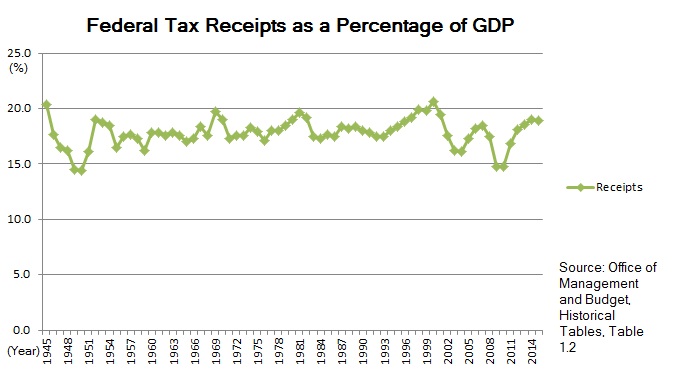
If every wage earner, both individual and business, paid the same flat tax rate to the Federal Government, that tax rate would need to be 22.44%, or an average of $11,927 out of that $37,075.50. (by the way, that doesn't take into account the number of actual wage earners, it's total population in including our kids and elders.)

Now, 22.44% is a slightly higher tax rate for Americans than we are used to.  Here's a graph showing what it has been over the last half-century:

http://upload.wikimedia.org/wikipedia/commons/7/75/U.S._Federal_Tax_Receipts_as_a_Percentage_of_GDP_1945%E2%80%932015.jpg

If you consider that with a balanced budget we could really get serious at creating jobs, rebuilding our crumbling infrastructure and actually start paying down the Debt, maybe this would be worth it.

But, nobody is talking about charging everyone $11,927.  Some people earn more, and they pay more.  Some people earn less, and they pay less.  But if we all paid our share, and we stayed focused on the idea that we need to pay enough to balance the budget, we could.

Do we want to?  I do.

Saturday, April 26, 2014

Fixing our monetary system

Our current monetary system has three major flaws. What we have to do is find a way to manage these flaws.

The first problem is Fiat Currency. We need currency based on something tangible, not just promises to pay. But we can't go back to the gold 
standard, and the suggestion of sunshine that I saw in an earlier comment wouldn't work because it would give equatorial regions an advantage. My idea would be a currency based on carbon. Not carbon credits, but actual carbon pulled out of the atmosphere and stored in bulk. It's physical and measurable.

The second problem is Fractional Reserve Banking, where banks only have to maintain a fraction of their deposits in the central bank in order to give out loans. This is simply a matter of law. In the 1930's, with the bank reforms pushed through by FDR, the reserve requirement was pushed up. The higher the reserve requirement, the less money the private banks could just invent out of nowhere. This helped keep inflation under control, but I don't think it ever got above 26% in the US. It's much higher in some other countries.

The third problem is Compound Interest, where we pay interest upon interest upon interest again and again and again. I recently got a debt consolidation loan that had a fixed rate, without any compounding. It's wonderful. I think all loans and credit cards should be like that. Need a loan for 10K at 10%, you'll pay $1K in interest for a total of $11,000. That's it. This could be required by law.

The banks would fight these changes tooth and nail every step of the way, but if we made changes like these it would bring our monetary system to heel and make it a servant of the people instead of our money being our master and us being the slaves.

Sunday, March 30, 2014

From Washington State Democrats, how to help Oso

Like you, we are stunned and devastated by the destruction caused by the Oso mudslide.
We’ve already lost over a dozen Washingtonians. With many still missing, this could be one of the deadliest natural disasters in state history.
When one community in our state is hurt, it hurts us all. Our hearts are breaking for the victims taken by this disaster, their families, and all those affected.
With tragedies like this, heroes emerge. We learn about the strength in our communities that we didn’t know was there.
We thank and honor the first responders, relief organizations, civic and government leaders, volunteers, and all those who are working day and night to help those affected.
It’s hard not to feel powerless at times like this. But a donation to help the relief effort is one way that we can do our part.
In solidarity,
Jaxon Ravens
Washington State Democrats Chair

Monday, October 07, 2013

Learn more about the ACA (Obamacare) at Planned Parenthood!

Want to learn more about the Affordable Care Act?  One of the best places to go (in my humble opinion) {Wait, have I ever had a "humble" opinion?} is Planned Parenthood of the Great Northwest.  They have twelve ACA In Person Assisters (ACA-IPA) {Sounds like a beer from Elysian}, and they are in PPGNW clinics in the following cities:
Centralia, Everett, Lynnwood, Marysville, Olympia, Port Angeles, Puyallup, Shelton and Tacoma.

In addition, clinics in King County are looking for a few good volunteers {Interviews in progress} to provide assistance to people looking for more information.  It's an unfunded contract, but if you're interested in helping people that's a great place to go!  And they will be there until coverage begins in January, at least.

Here's a web page to learn more:
http://www.plannedparenthood.org/ppgnw/affordable-care-act-41851.htm

And here's a paragraph from that page that applies:

"If you are interested in talking to an assister or setting up an appointment for enrollment assistance: Call 206-320-7610 or send an email to ipa@ppgnw.org.  Include your zip code, and someone will get back to you."

Wednesday, May 01, 2013

The path across the Rubicon

I saw a post on Facebook linking to an NPR article about how the US Treasury is paying down $35 Billion dollars of the National Debt. This is the first time in 6 years that they have done this, so before the 2008 crisis. A couple of questions come to mind.

First, how are they doing this? Are they retiring some of the Treasury bonds early? Normal Treasury bonds are 30 year bonds, although they have shorter term bonds out there as well. Which ones are they paying off? Who owns them?

Second, if this was done 6 years ago, sometime in 2007, why don't I remember hearing about it? Is this something that the Treasury does on a semi-regular basis, no matter who the President is? It reminds me of posts in 2009 up to today clamoring for the President to re-install the solar panels on top of the White House that Reagan had removed in 1981. Actually, if you truly pay attention to the news, you would have knows that President Bush reinstalled them through the National Parks Service near the end of his first term in 2003. Not everything is black and white. I wouldn't have expected a Republican President to direct the Treasury to pay down the National Debt, but I guess he must have.

Third question came from another search result that came up when I was looking for more information. It seems that NPR did a story about a government report from the year 2000 talking about the changes that would need to happen if the Federal Government was able to retire ALL of the debt. There are some major foundational aspects of our financial and monetary system that would have to change, and the report talks about them.

First, investors looking for an asset free of credit risk can no longer count on an abundant supply of U.S. Treasury securities, and Treasury securities may no longer provide a reliable benchmark for other interest rates.

Second, the Federal Reserve may have to change the mechanisms by which it conducts monetary policy.

Third, continued surpluses after the public debt has been paid off will require the Federal. government to acquire assets; either directly or though the Social Security Trust Fund. This raises issues about what kinds of assets might be acquired, and the best way to manage this task.

This research brought me back to a concept I've been thinking about for several years, wondering how a government agency could operate without debt. I believe that our monetary system has flaws, and they have been identified many times in many different venues. The most blatant expression of them was in the movie Collapse, which is about the work of Michael Ruppert. He identifies three main issues with the current monetary system.

  • Fiat Money, value set by a promise, not connected to any real commodity like Gold.
  • Fractional Reserve Banking, with banks only required to hold a percentage of their on-book assets in the central bank.
  • Compound Interest, meaning that we pay interest on interest on interest when we take out a loan.

There are solutions for these issues. It's not easy, and it takes a great deal of change in the way we think about money. But it would be possible. If anyone is interested, I can expand on these ideas and continue. But please let me know that you're reading by commenting below.

Tuesday, January 08, 2013

Basic Mortgage Rules

This is a list of the fundamental rules that should apply to all mortgages, at least if we want the housing market to be part of the foundation of the economy.  Any relaxation of these rules, at least given our current monetary system, threatens to undermine the entire system.

1. 30 year fixed rate.  No  more variable rate mortgages.  If someone signs to buy a house, it needs to be a fixed rate for the entire length of the mortgage.

2. Max 30% of household income.  If someone doesn't earn enough to pay the calculated mortgage payment based on the 30 year fixed rate, then they can't afford the house and should not qualify for the mortgage.  It's just too hard on families to have 40%, 50% or more going into housing.

3. Minimum 20% down payment.  Saving money is a critical skill, and if someone can't save up money to pay a down payment on a home, then they don't have a handle on their finances well enough to be a secure credit risk.

4. Mortgages may not be sold to other banks.  No more mortgage backed securities or derivatives.  If a bank goes out of business, that's another can of worms, but a bank should be held to the risks of the loans they issue.

These are severe restrictions on the current housing market.  I know that.  I also know that foundation level rules like this create a way to prevent people crashing through the floorboards and our entire economy held hostage by foolish investors who don't live in or care about the communities they are lending to.  It's just too expensive not to establish rules like this.

Friday, September 14, 2012

Minecraft and the Industrial Revolution


I've been playing Minecraft for about a year, and I'm having a lot of fun.  My son got me into the game, and it's pretty much an addiction.  Go figure, that's why it's one of the  most successful independent games out there.

What I've been enjoying the most is the Mods that are out there, and the skill and imagination that people are putting into their work.  I've watched most of the Youtube videos from people like Direwolf20 and Zerzera, and it's amazing how they can get the different components of multiple mods to connect and interlink to create incredible machines and systems that do what they want done.  It's people like this who I want involved building space stations and moon bases.  I'm not kidding.  If we give our kids games like this, open sandboxes with resources, tools and self-defined goals, they'll train themselves to be able to put things together that will amaze us all.  And even better, this is an international movement.

What I was thinking about this morning was from the book that I'm currently reading, Peak Everything.  The Industrial Craft mod adds generators that burn coal, and oil that you can burn or refine into fuel, which is more efficient in generating electrical power.  The Forestry mod adds biogas and other plant derived fuels like peat which you can burn like coal.  The goal, of course, is to have more and more power available in various forms to run machines and tools.  Just like in the real world.

What seems to be missing is costs associated with it.  There's no pollution from burning the coal, there are no lasting effects from the oil that gets spilled in water or on land.  There's no way to see environmental impacts.  Of course, it's a game, and such things would spoil the game environment and make it "too much" like the real world.

But it is real.  And while I can understand wanting to play a game without the costs, some of us are thinking about and working on solutions to these problems in the real world and we're looking for help from the imaginations of our kids to find the solutions that will keep our real world able to support us for the long term.  So something needs to be added, as an option, to help keep pollution and environmental effects in mind.

The best example of what I'm looking for already exists in the game, but it's part of a non-technical mod, although one that many people who play and record the game are using as a technical mod.  I'm referring to Thaumcraft2, a mod that adds magic to the game including "vis" for positive energy and "taint" for negative energy.  Players can research how to use resources in new ways to create new tools and machines, and can even give themselves the ability to see the levels of vis and taint in the surrounding environment (which is a 16x16 block going from the top to the bottom of the world).

What if, and I'm posting this because this is far above my own programming skills, burning coal in Industrial Craft caused pollution, and spilling oil on water or land caused additional pollution in the surrounding chunk.  And there would be a way to create a visor or something that lets you see the level of pollution.  And maybe a new machine that would help you reduce the pollution from the chunk.

Again, this would be an additional mod to Industrial Craft itself, so optional only if you want to use it.  But it would bring the game a bit closer to the real world, and get our kids aware of sources of pollution and what they could do about it.

Tuesday, June 12, 2012


In 2003, one of my last classes at the University of Phoenix was State and Local Government. One of my projects was to attend a local political meeting, and I found the 46th LD meeting just up the road. That was May, 2003, a meeting that will live in infamy. LaRouche supporters standing on chairs singing protest songs until the police came to take them outside. I couldn’t wait to get involved.

I was elected as an At Large member in 2005, KCDCC Male Rep in 2007 and Chair in 2009. It has been a lot of work, and a lot of fun.

In 2009, my youngest son moved up from California to live with me. He is a great kid. I have tried my best to find a balance between my family and my political activism, and it’s a very hard balance to find. I’m afraid searching for that balance is outside of my technical and leadership skills that have served the district so well over the past 10 years.

The June meeting of the 46th District will be my last meeting as Chair. I am not abandoning the ship, I’m simply asking for someone else to step forward to take the captain’s chair. Shea starts high school in September, and I want to give the new chair the time to learn the details in time for us to have a successful election, helping President Obama and all of our statewide candidates win state-wide majorities with the help of the strongest and most capable Legislative District in the State. I’m VERY proud of this district and the many people who work so hard to keep it together. The Eboard is ready to help a new chair get the job done.

Can you believe that 128 people filed to be PCOs?! The next highest number was the 36th and 34th, which were tied at 111. Scott and his team are continuing to call new people to ask them to step up, and we appoint new PCOs at every meeting. That’s the kind of strength I’m talking about.

The June meeting will be at Aljoya, and I’ll be talking about how the District Organization operates, how people can get involved, and we’ll also do a PCO training to show Votebuilder and how we can be most effective for the Primary and General Elections.

Thank you for the past 10 years. I couldn’t have done it without the examples of our former chairs.


Chad Lupkes
Chair, 46th District Democrats

Wednesday, June 06, 2012

Resignation from King County Democrats

Dear Steve,

I want to thank you for your leadership of the King County Democrats over the last two years.  You stepped forward to lead when it was needed.

At this point in time I need to step back.  My son, Shea, begins high school in September, and my activities in politics over the last 3 years have been at the expense of my family.  I have come to the point where I need to make a choice.  And the choice was easy, once I realized that I was unable to continue to do both.  Family comes first.

I hereby resign my position as 3rd Vice Chair of King County.  I know you will find someone to take the position and help you lead the party through the end of the cycle.

Leadership comes from example, and it is time I be a good example for my son.  Good luck.

Chad

Friday, February 03, 2012

Something missing from the Komen vs. Planned Parenthood narrative

I was infuriated beyond reason when the Susan G. Komen Foundation decided to yank funding from Planned Parenthood. I threw out some pretty heavy twitter posts demanding the resignation of the Vice President of Komen who was a former conservative Republican elected official in Georgia, I watched the twitter attacks and goaded them on, and I was relieved when they reversed their decision.

Except they hadn't.

Here's the problem I see that is not getting enough coverage. Conservatives have been saying for decades that welfare programs and other programs that help the poor by using tax money are beyond the scope of our government because the non-profit charities and churches should be sufficient to cover the need. They know they are lying, but they keep saying it.

At the same time, they are putting people into positions of power within those very non-profits that are focused on helping people, and then coming out with statements like this:

Our original desire was to fulfill our fiduciary duty to our donors by not funding grant applications made by organizations under investigation. We will amend the criteria to make clear that disqualifying investigations must be criminal and conclusive in nature and not political. That is what is right and fair.

Right and fair? No. Heck no. Because what this says is that anyone in Congress can put together the paperwork to begin a "criminal" investigation against a group helping the poor or with a politically motivated bend, and they can again pull the plug on donations.

It's not the mission of non-profit groups to "fulfill a fiduciary duty to their donors". That's insane. That's corporate speak for not giving a zing about their communities and the people they are supposed to be serving.

It's not time to pull back on the social media coverage on Komen and the larger problem of conservatives taking over our entire society with their "I don't give a ding about those people over there" ideas. It's time to double down. And it's time to kick the entire Conservative Movement back across the ocean, which we did originally in 1776.

Thursday, January 05, 2012

On the subject of PCO elections

The following is a comment that I have been building and collecting from comment threads where I have been defending the lawsuit filed by the Democratic, Republican and Libertarian parties against the Secretary of State to keep Precinct Committee Officers an publicly elected position.  I just don't understand why media institutions and editorial pages are getting behind this.  It seems they are in denial of the Constitution and the core foundations of our democratic institutions.

In the event of a vacancy, the State Constitution says that the County Central Committee of the party of the person who left the seat shall present three names to the County Legislative Authority so they may appoint a replacement to fill the seat. The RCW says that the County Central Committee consists of Elected and Appointed Precinct Committee Officers. This is not a private function, it is a public function, and one that we have to be ready for at any time. The King County Central Committee just went through that process to replace Senator Scott White in the State Senate. This is a critical public function for Precinct Committee Officers, and thus the political parties are asking for the PCO position to be filled by a public election within their precinct.  Contrast that with the Olympia City Council, which had to go into closed executive session to discuss the qualifications of candidates to fill a vacancy, or the King County Council which was made "non-partisan" by referendum a few years ago and had to go through months of haggling to fill the seat vacated by Dow Constantine.  If these decisions were made by elected members of a party, the entire process would have been open and it would have been done quickly so our representatives could get on with the business of governing, which is their job.

Another example that I see in these comment threads:  The Electors whose votes are counted and sent to Washington DC to elect the President of the United States are elected at Congressional District Caucuses held each Presidential year. The delegates to those CD Caucuses are elected by Legislative District Caucus delegates who are in turn elected by Precinct Caucus attendees. The Precinct Caucuses are presided over by the Precinct Committee Officers, who up to now have always been elected by the public and are recognized and trained publicly elected officials presiding over these neighborhood meetings to ensure that they are organized and run properly and efficiently as to not waste people's precious time. This is a critical public function, and an important part of our democracy. To close the process off from public election at the lowest grassroots level would damage our democracy and hurt our state.

Another point I would like to make is that the political parties have tremendous power in regards to our electoral and political process, power which can be either concentrated or distributed.  In our society, it is in our best interest to have that power distributed as much as possible, and having PCOs elected from the public INTO that party structure at the grassroots level ensures that power is distributed and not concentrated in the hands of a few.

Certainly there are plenty of internal Party politics stuff, and I would mostly agree that they should be dealt with internally. But for me the bottom line is not the meetings and activism, it's the core purpose of having locally elected public officials, so that when important decisions on who represents a district in the event of a death or resignation, it's as public as possible. Or when it comes time to identify our Electoral Collage members so that Washington State's voice is heard in Washington DC for the most important election in the world, the people who run the meetings at the very beginning of the process have some idea of how to run a meeting.

People who object to the parties outright make me wonder if they are basing all of their stated opinions on what they read in the media instead of real personal experience. Political parties are groups of people who really care about our communities. If you doubt that fundamentally, then we really need to have a longer conversation. I got involved in the Democratic Party in 2003 because I shared the idea at the time that they were closed groups making decisions in smoke-filled back rooms. As soon as I got involved, I realized I was wrong. It's not the parties that have been strangling our state, it's our political atmosphere that fosters the notion that the only way to get anything done is by achieving power through the exercise of control, rather than reaching for peace through the exercise of cooperation. That goes much deeper than the parties, and includes the transformation of our media, our education system, and our core values as a country.

Like I said, this needs to be a much longer conversation than just about PCO elections. The people of Washington have always had an independent bend, and that hurts our understanding of the purpose of political parties from the very start. I grew up in Kent, so I'm not an outsider. I just know we've been wrong about political parties since our ideas of them were skewed by the Grange in the early 1900's, and most people don't give the parties a chance to do what they are supposed to be doing.

What these editorial boards are suggesting is that PCO elections be paid for by the political party.  As if we having democratic institutions paid for is not the purpose of government.  This would likely result in the PCOs being appointed by the political party leaders instead of the public, which would result in much more of a closed political party structure making all of these important and representative decisions in a closed room instead of public officials meeting in public to make public decisions. This is not healthy for our democracy, and it is the wrong direction for our state.  And all of the major political parties, Democrats, Republicans and Libertarians, see it the same way.  All three have signed onto this lawsuit.

Our democratic processes cost time and money, just as any process does in the public or private sphere. While many of the functions of PCOs, Legislative District Organizations, County Central Committees and State Party Organizations may seem strange and arcane, they exist in order to amplify the voices of activists who freely choose to get involved in order to ensure their voices are heard in our government. It is worth the cost to ensure that these democratic processes are maintained and kept in the public sphere. Too many of the important decisions that our government makes are behind closed doors, with the voice of the public not heard or outright ignored. Please don't create or advocate for a situation where our political parties also close the door on the public, simply because county auditors are unwilling to do their duties as defined by the Constitution and the RCW.

What is the alternative, and where would that alternative lead us in terms of our bottom up grassroots people powered democratic institutions? Just saying "I don't want to pay taxes for this" isn't enough. What is the opportunity cost? I see it as Tammany Hall or a hyper powered party with no regard to the voice of the public, and I don't want to go there. Having tax money go to pay for PCO elections to prevent the corruption of our political process is well worth those tax dollars. At least to me.

Tuesday, January 03, 2012

Investments report, 2011

2011 was a crazy year in a lot of ways, but my investment strategy seems to be working just fine.

I ended the year with a total account value of $8,114.17.  I had put in $2,400 directly from my paycheck over the last 12 months.  My total dividends for the year added up to $650.64, up from $266.65 the previous year, mostly because I was putting so much in myself.

Over the next 12 months, I'm currently calculating a dividend return of $974.69, or 12.02% yield.  Of course, I'll be putting in another $2,400, plus buying additional shares and getting dividend reinvestments along the way so the dollar total will probably increase.

As far as share value goes, I only look at the summary screen, and it is telling me that I have lost $44.97 or 0.78%.  That's overall based on the original purchase of each share compared to now.  My highest gain in dollar terms was AT&T, which gained $363.55 or 24.17%, and my greatest loss was Chimera Investments which lost me $273.42 or 35.01%.  CIM is still paying a 20.08% dividend yield, probably because the share value has dropped so much, but as long as it is paying it's worth holding on to until the share value reaches 20% of what I bought it for.  CIM is one of the shares that pays me over $100 per year in dividends, and until that changes I'll hold on to it.

Overall, 2011 was a good year for my investment strategy.  I am up to 2.17% of my goal, which is to earn $45,000 per year from dividends alone.  I have a ways to go, but I can see it happening within 15 years or so.  Just in time for early retirement, as long as the world is still here for me to enjoy.